
Be The Voice For The Voiceless® means speaking for animals wherever they’re hurt, including when it happens in the name of faith. We oppose practices that make animals suffer, and animal sacrifice is one we’ve spoken out against for years. If you’ve seen an animal you think is being harmed, call our Animal Abuse Hotline at (844) 728-2729. If an animal is in immediate danger, call 911 first.
What Is Animal Sacrifice?
Animal sacrifice is the ritual killing of an animal as an offering in a religious ceremony, and it’s practiced in the US and abroad.
In the US, the case that reached the Supreme Court involved Santeria, which a U.S. Courts case summary describes as blending the Yoruba religion of West Africa, carried to Cuba by enslaved people, with elements of Roman Catholicism. According to the Supreme Court, animal sacrifice is one of Santeria’s principal forms of devotion. The U.S. Courts summary says sacrifices are performed at birth, marriage, and death rites, for the cure of the sick, for the initiation of new members and priests, and during an annual celebration. The Court’s opinion says the animals are killed by cutting their carotid arteries, and that they’re cooked and eaten after all Santeria rituals except healing and death rites.
Where Animal Sacrifice Still Happens Outside the US
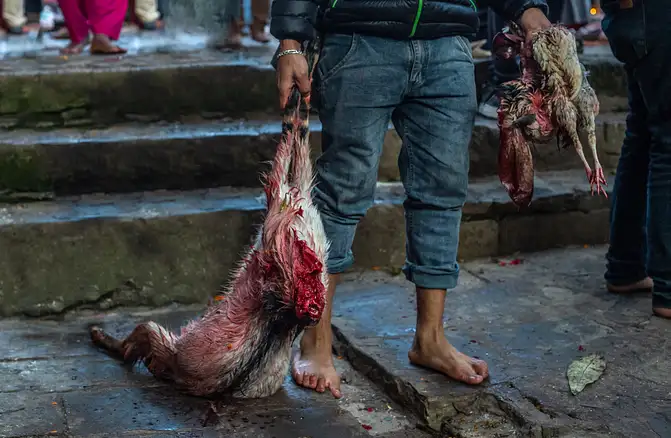
One of the largest examples is the Gadhimai festival, held every five years in Nepal. Humane World for Animals describes it as the world’s largest animal sacrifice event, where buffalo, goats, pigs, pigeons, and chickens are beheaded as a sacrifice to the goddess Gadhimai. Its Indian affiliate and the group People For Animals have campaigned at the site since 2014, and they estimate the number of animals killed fell from more than 500,000 in 2009 to about 200,000 in 2014, then to tens of thousands in 2019. Persistent pressure made that difference.
Is Animal Sacrifice Legal in the United States?
The answer comes from a 1993 Supreme Court case, Church of the Lukumi Babalu Aye v. City of Hialeah. It started in Hialeah, Florida. After a Santeria church leased land in the city and announced plans for a house of worship, the city council held an emergency public session and passed a set of laws aimed at religious animal sacrifice. Those laws left almost every other kind of animal killing alone. According to the U.S. Courts summary, they made exceptions for comparable killings and for other religious purposes, including kosher slaughter.
The Supreme Court struck the laws down. It found they weren’t neutral, because their object was to suppress Santeria’s central practice, and they weren’t generally applicable, because they went after religiously motivated conduct alone. Under the Free Exercise Clause of the First Amendment, a law like that has to pass the strictest review, and Hialeah’s didn’t.
Here’s what the ruling means in plain terms:
- A government can’t single out religious animal sacrifice for a ban while allowing similar killings for other reasons.
- The Court said a law that’s neutral and applies to everyone doesn’t need the same justification, even when it burdens a religious practice.
- The Court pointed to general rules on disposing of organic waste, on caring for animals regardless of why they’re kept, and on methods of slaughter as ways a city could protect public health and prevent cruelty.
- State laws differ, so how this plays out depends on where you live.
Where We Stand on Animal Sacrifice
We believe every animal deserves protection from cruelty, whatever the setting. That’s why we push for strong animal cruelty laws and for those laws to be enforced when an animal is hurt. If you agree, add your name to our petition on animal sacrifice.



What to Do If You See an Animal Being Hurt
The steps are the same in any setting. The ASPCA recommends:
- Call 911 if a crime is in progress or an animal is in immediate danger.
- Otherwise, contact the agency that enforces animal laws where it’s happening. That may be local police, animal control, an SPCA, or another humane organization. If you’re not sure which, local police or animal control can tell you.
- Write a short, factual account of what you saw, with dates and times, and note anyone else who saw it.
- Take photos or video only from a place you’re legally allowed to be, such as a street. Never trespass to get them.
Then call our Animal Abuse Hotline at (844) 728-2729. You can report without giving your name, though the ASPCA notes that cases are more likely to move forward when a witness is willing to stand behind the report. Our guides to reporting animal abuse anonymously and reporting animal abuse in Virginia walk through the details.
Reports also count in a bigger way. Since January 1, 2016, the FBI’s National Incident-Based Reporting System has collected data from participating law enforcement agencies on animal cruelty, including gross neglect, torture, organized abuse, and sexual abuse.
For more of our work on this issue, read about dog and animal sacrificing and the different types of animal cruelty. To give your time, see the ways to get involved with us.
Frequently Asked Questions
Is animal sacrifice legal in the United States?
In 1993, in Church of the Lukumi Babalu Aye v. City of Hialeah, the Supreme Court ruled that a city can’t single out religious animal sacrifice for a ban. Laws that are neutral and apply to everyone, such as rules on animal care, slaughter methods, and disposal of remains, are judged differently, and state laws vary.
What religions practice animal sacrifice?
In the US, the Supreme Court has ruled on Santeria, and it described animal sacrifice as one of that faith’s principal forms of devotion. Outside the US, the Gadhimai festival in Nepal, held every five years, has involved the sacrifice of tens of thousands of animals.
What happened in the Santeria animal sacrifice case?
A Santeria church planned to open a house of worship in Hialeah, Florida, and the city passed laws banning ritual sacrifice while allowing most other animal killings. The Supreme Court struck those laws down in 1993 because they targeted one religion.
Can I report animal sacrifice?
You can report any animal you believe is being hurt or neglected. Call 911 if the animal is in immediate danger, contact local animal control or police, and then call our Animal Abuse Hotline.